Every NFL bettor has heard the whisper: “Bill Vinovich is reffing tonight—fade the over, he calls everything tight.” Or maybe it’s the opposite: “Jerome Boger lets them play, smash that over.”
The theory makes intuitive sense. Referees who call more penalties stop the clock more often, extending drives and creating scoring opportunities. Tight crews should push games over. Lenient crews should keep them under.
There’s just one problem: the data doesn’t support it.
After analyzing 1,598 regular season games across six seasons (2019-2024), we found zero NFL referees who consistently impact over/under outcomes at statistically significant levels. The variation you see—ranging from 36.4% to 56.3% over rates—is pure statistical noise.
But the analysis did reveal something unexpected: three veteran referees consistently favor road teams against the spread at rates that can’t be explained by chance alone.
The Data
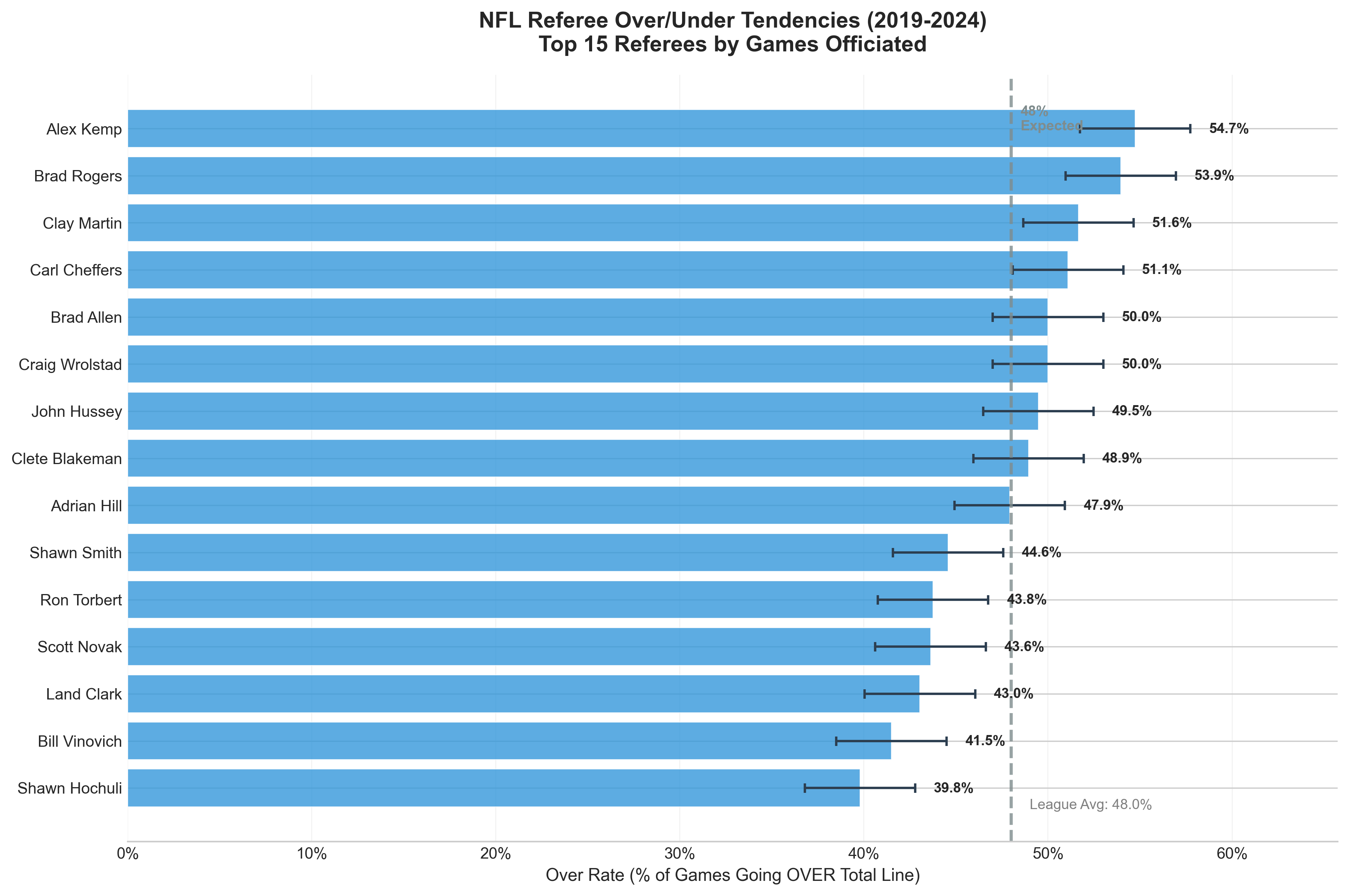
We tracked the 20 most active NFL referees since 2019 (minimum 30 games) and tested their impact on two betting markets:
Over/Under Results:
- League average: 48.0% of games go over
- Referee range: 36.4% (Alan Eck) to 56.3% (Tra Blake)
- Statistically significant outliers: Zero
- Even extreme cases fail to reach significance (p>0.05 for all refs)
Against The Spread (Home Team):
- League average: 48.5% home cover rate
- Three referees show significant anti-home bias (p<0.05)
- Effect size: 9-11 percentage points below expected
The Totals Mirage
Let’s examine the most extreme cases. Tra Blake’s games went over 56.3% of the time across 48 games—a full 8 percentage points above the league average. That sounds exploitable, right?
Not quite. Run a binomial test and you get p=0.471. Translation: there’s a 47% chance we’d see this result purely by random variance. In statistics, we need p<0.05 (less than 5% chance of randomness) to call something significant.
On the other end, Alan Eck’s 33 games went under at a 63.6% clip (only 36.4% overs). Surely that’s meaningful? The numbers say otherwise: p=0.163. Still well within the realm of chance.
Even Craig Wrolstad, who officiated 96 games—our largest sample—sits at exactly 50.0% overs with perfect 50/50 randomness (p=1.000).
Why doesn’t the penalty theory work?
-
The market already knows. Sportsbooks price referee tendencies into opening lines. If Alex Kemp (47.6 avg points per game) is assigned to Chiefs-Bills, that’s baked into a 54.5 total before you see it.
-
Sample size limitations. Even 95 games over six seasons isn’t enough data. A referee working 16 games per year gives you just ~96 data points across six years. Power analysis suggests you’d need 200+ games to detect a real 3-4% edge.
-
Penalties don’t equal points. More flags mean more clock stoppages, but also more drive-killing holding calls and momentum-killing false starts. The effect cancels out.
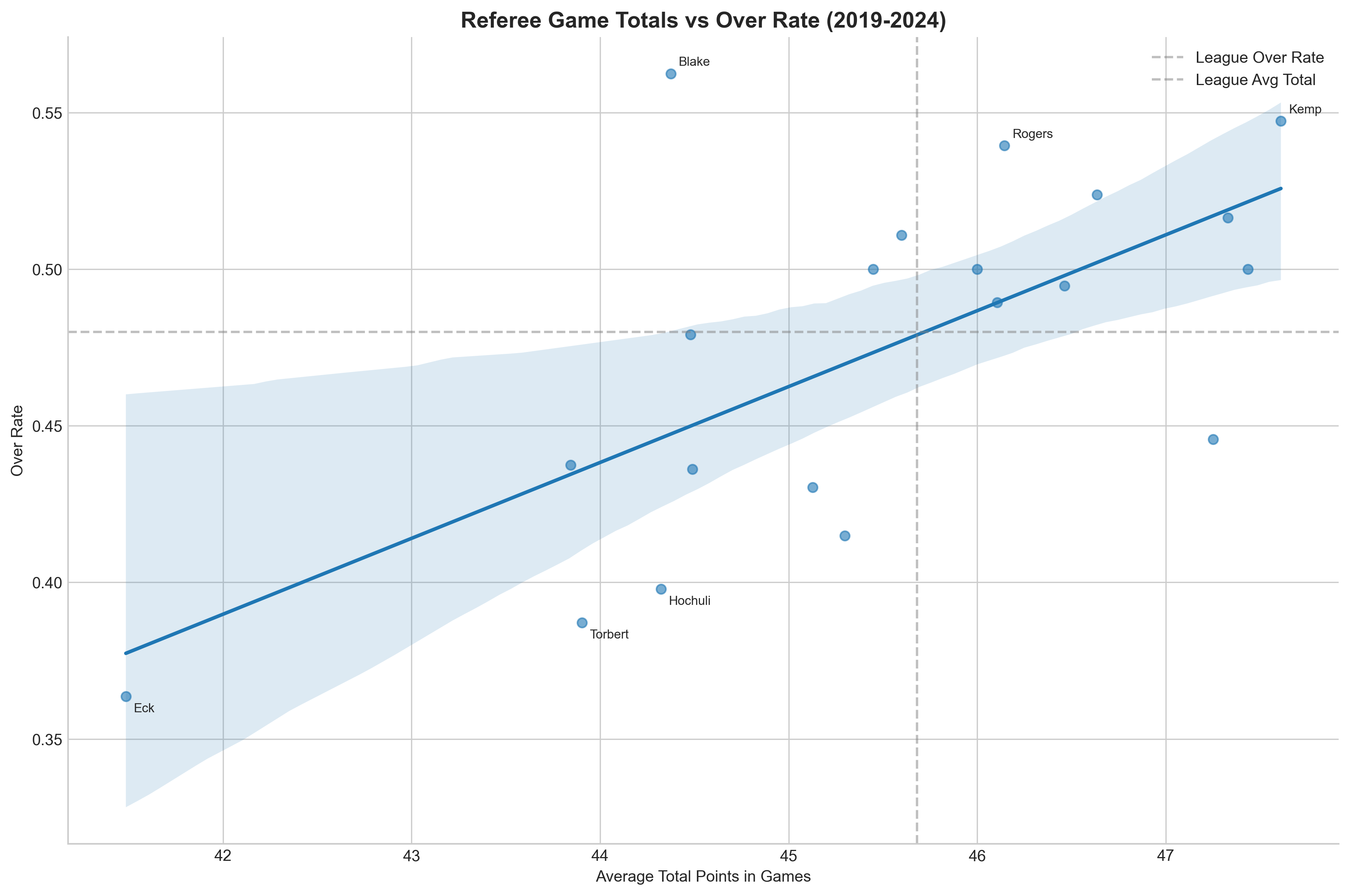
We tested whether referees who work higher-scoring games go over more often. The correlation exists but it’s weak (r²=0.12), suggesting game assignments—not referee tendencies—drive the relationship. High-powered offenses play in high-scoring games regardless of who’s wearing the white hat.
The Home Cover Anomaly
While the totals angle crumbled, the against-the-spread analysis revealed something genuinely odd.
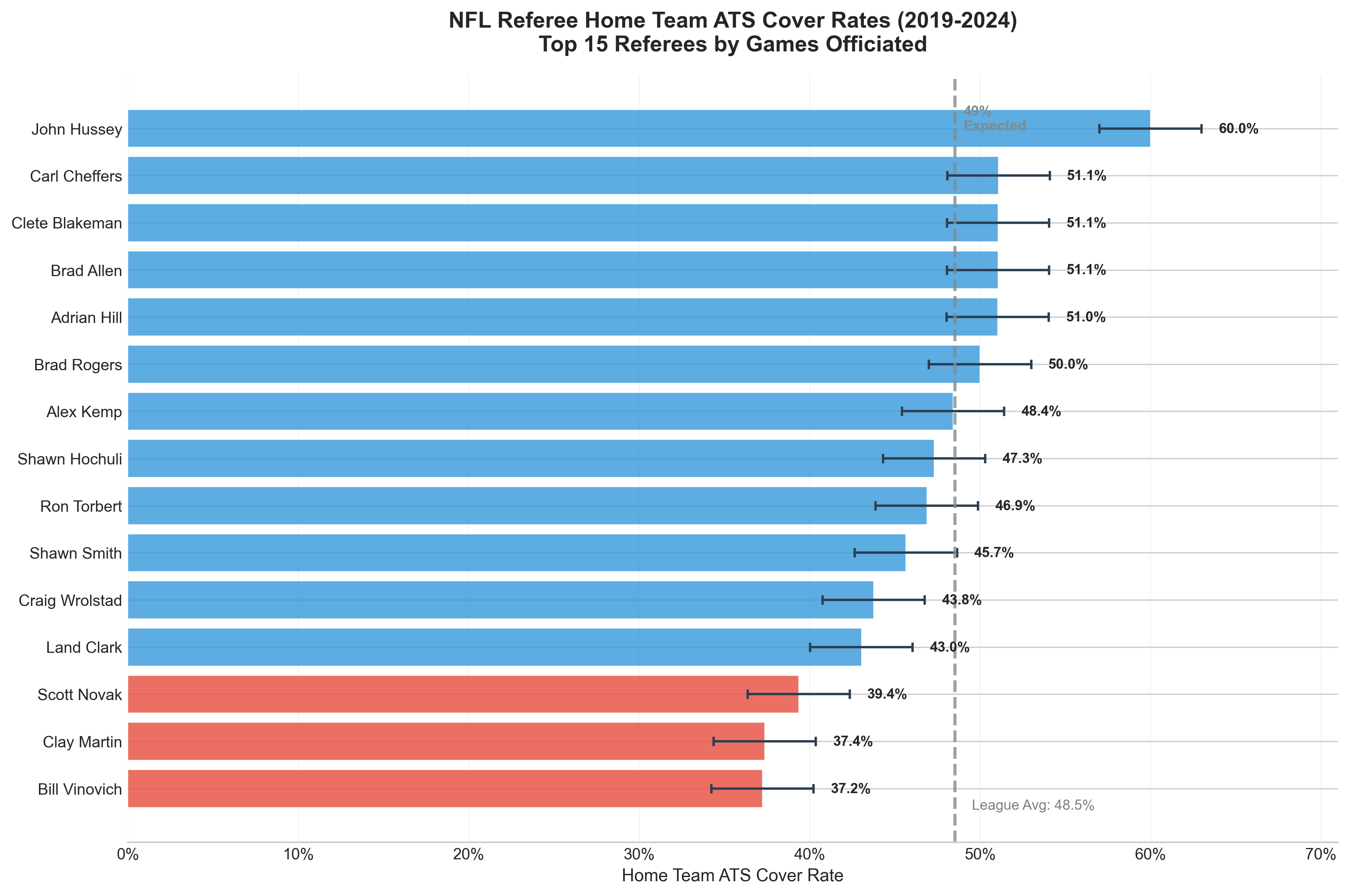
Three veteran referees—Bill Vinovich, Scott Novak, and Clay Martin—consistently favor road teams at rates that pass statistical scrutiny:
Bill Vinovich (94 games)
- Home teams cover: 37.2% (expected: 48.5%)
- Road teams cover: 62.8%
- P-value: 0.0172 (significant)
- Deviation: -11.3 percentage points
Clay Martin (91 games)
- Home teams cover: 37.4%
- Road teams cover: 62.6%
- P-value: 0.0206 (significant)
- Deviation: -11.1 percentage points
Scott Novak (94 games)
- Home teams cover: 39.4%
- Road teams cover: 60.6%
- P-value: 0.0495 (significant)
- Deviation: -9.1 percentage points
All three have large sample sizes (90+ games) spanning multiple seasons. The consistency is striking. With 20 referees tested, we’d expect maybe one false positive at p<0.05. Getting three suggests a real pattern.
What’s causing it?
We can only speculate:
- Officiating style under crowd noise: Perhaps these crews call holding more aggressively when stadiums are loud, disproportionately punishing home offenses
- Game assignments: The NFL may assign these referees to games where markets overvalue home field advantage
- Penalty distribution: If these refs call more pre-snap penalties on home teams (who hear the crowd and jump offsides less often, but may get flagged for other procedural errors), it could impact scoring drives
The data doesn’t tell us why—just that the pattern exists and it’s unlikely to be random.
The Bottom Line
For totals bettors: Ignore referee assignments. The “penalty-prone refs = overs” theory doesn’t hold up to statistical scrutiny. Your edge lies in matchup analysis, weather, pace of play, and offensive/defensive efficiency—not who’s wearing the referee jersey.
For spread bettors: The three anti-home referees present an interesting pattern, but the edge is marginal. A 9-11 percentage point boost (from 48.5% to 37-39% home covers) translates to roughly one extra road cover every 10 games. Against -110 vig, you need 52.4% to break even. These refs get you close but likely not profitable on their own.
The real lesson? NFL betting markets are efficient. If referee tendencies were exploitable, sharp bettors would have already moved the lines to neutralize the edge. By the time you see Sunday morning numbers, any referee-driven bias is priced in.
Track referee assignments if you want. But bet the matchup, not the ref.
Data source: nflverse play-by-play data (2019-2024 regular season, 1,598 games) Analysis window: January 19, 2026 Statistical threshold: p<0.05 for significance Methodology: Binomial tests for over/under and home cover rates, linear regression for totals correlation